DIY ABC Learning Design
About this resource
ABC Learning Design is a method developed by University College London (UCL) to help educators quickly design or redesign learning experiences. The workshop guides you through creating a visual storyboard of a module, course, or other learning programme from the learner’s perspective.
This DIY version, created by the Digital Education Team at the University of St Andrews, allows you to complete an ABC workshop independently, without a facilitator. All instructions and materials are provided in a Padlet workspace that you can copy and use for your own course design.
While ABC was originally developed for Higher Education modules, it can also be used for short courses, staff development programmes, non-credit learning, and other educational contexts.
New to ABC? No previous experience is required. The Padlet includes step-by-step instructions to guide you through the workshop activities.
What is the ABC Learning Design approach?
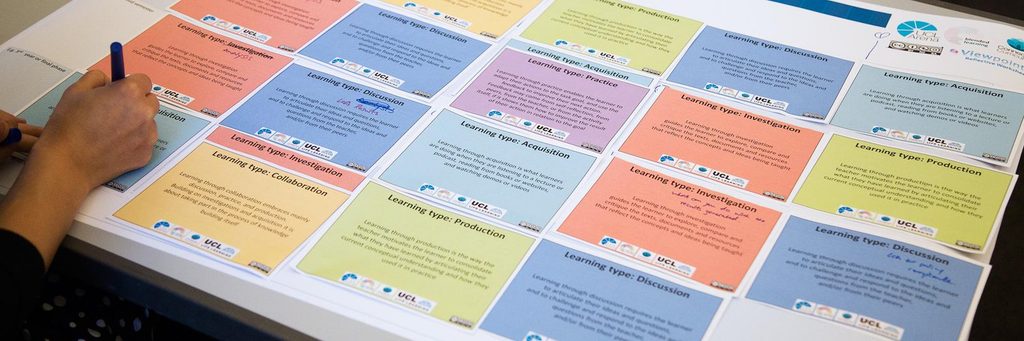
ABC Learning Design is based on six learning types from Laurillard’s Conversational Framework (2002). These learning types help you think about how learners interact with content, teachers, and each other.
The six learning types are:
- 📖 Acquisition: learning through acquisition is what learners are doing when they are listening to a lecture or podcast, reading from books or websites, and watching demos or videos
- 🤝 Collaboration: learning through collaboration embraces mainly discussion, practice and production. Building on investigations and acquisition it is about taking part in the process of knowledge building itself
- 🗨️ Discussion: learning through discussion requires the learner to articulate their ideas and questions, and to challenge and respond to the ideas and questions from their teacher and/or peers
- 🔍 Investigation: learning through investigation guides the learner to explore, compare and critique the texts, documents and resources that reflect the concepts and ideas being taught
- 🔄 Practice: learning through practice enables the learner to adapt their actions to the task goal, and use the feedback to improve their next action. Feedback may come from self-reflection, from peers, from the teacher, or from the activity itself if it shows them how to improve the result of their action in relation to a goal
- ✏️ Production: learning through production is the way the teacher motivates the learner to consolidate what they have learned by articulating their current conceptual understanding and how they used it in practice
Don’t worry if an activity seems to fit more than one learning type. The categories are intended as a planning tool rather than a strict classification system.
When should you use a DIY ABC Workshop?
The workshop works best when:
- Designing a new module or course
- Substantially redesigning existing learning materials
- Planning online, in-person, or hybrid learning
- Developing academic or professional learning experiences
- Mapping a short sequence of learning activities or an entire programme
What will you achieve?
By the end of the workshop, you will have:
- A storyboard of your module or course
- A sequence of planned learning activities
- A visual overview of how learners will engage with content
- A balanced mix of learning types across the learning journey
- Ideas for both in-person and digital learning activities
Before you start
To get the most from the workshop, you should have:
- Draft Intended Learning Outcomes (ILOs)
- Draft assessment plans
- A general idea of:
- Who your learners are
- What they need to learn
- Key topics or concepts to be covered
- Any existing module documentation (for redesign projects)
Who should take part?
ABC workshops are often most effective when completed collaboratively.
Consider inviting:
- Module leaders
- Teaching staff
- Professional services colleagues
- Students (where appropriate)
You can also complete the workshop on your own.
Time required
We usually run facilitated ABC workshops in 90 minutes.
For the DIY version, we recommend setting aside:
- At least 60 minutes for a focused session
- Up to 90 minutes if working with a group
How to run your ABC
Accessing the workshop
The DIY ABC Workshop is hosted in Padlet:
🎨 DIY ABC Workshop: https://padlet.com/universityofstandrews/self-service-abc-bb6la39cnyitzl57
We recommend opening the Padlet and familiarising yourself with the layout before setting aside time to complete the workshop.
To participate fully, you will need to create or sign in to a Padlet account using your University Microsoft account. Instructions for doing this are provided below.
Important: To edit and save your own version of the workshop, you will create a personal copy of the Padlet using the Remake button. Your copied Padlet belongs to you, and the Digital Education Team will not have access to it unless you choose to share it.
Create or log into your Padlet account
- Go to Padlet.
- Select Sign in with Microsoft.
- Enter your University email address and password.
Using your University account ensures you have the permissions needed to use all workshop features.
Starting the workshop
- Open the DIY ABC Padlet.
- Select Remake (top right corner) to create your own editable copy.
- See the instructions in the Getting Started column for more.
Completing the workshop
Work through the Padlet columns from left to right.
The workshop contains four activities that will guide you through creating your course storyboard.
How to use the cards
- Purple cards contain instructions and activities.
- Yellow cards provide prompts, examples, and additional guidance.
Complete each activity in sequence, adding your ideas and plans to build up a complete storyboard of your learning design.
Need more support?
The DIY version is designed to be completed independently. However, if you would prefer a facilitated experience, search for ABC Learning Design Workshop on PDMS. Facilitated workshops are typically offered several times each year by the Digital Education Team.
Remember: the aim is to explore ideas and develop a coherent learning journey for your students. There is no single “correct” outcome, so feel free to adapt the process to suit your context and goals.